
Baptize BAP
Ascending to the Next Anthropological Stage

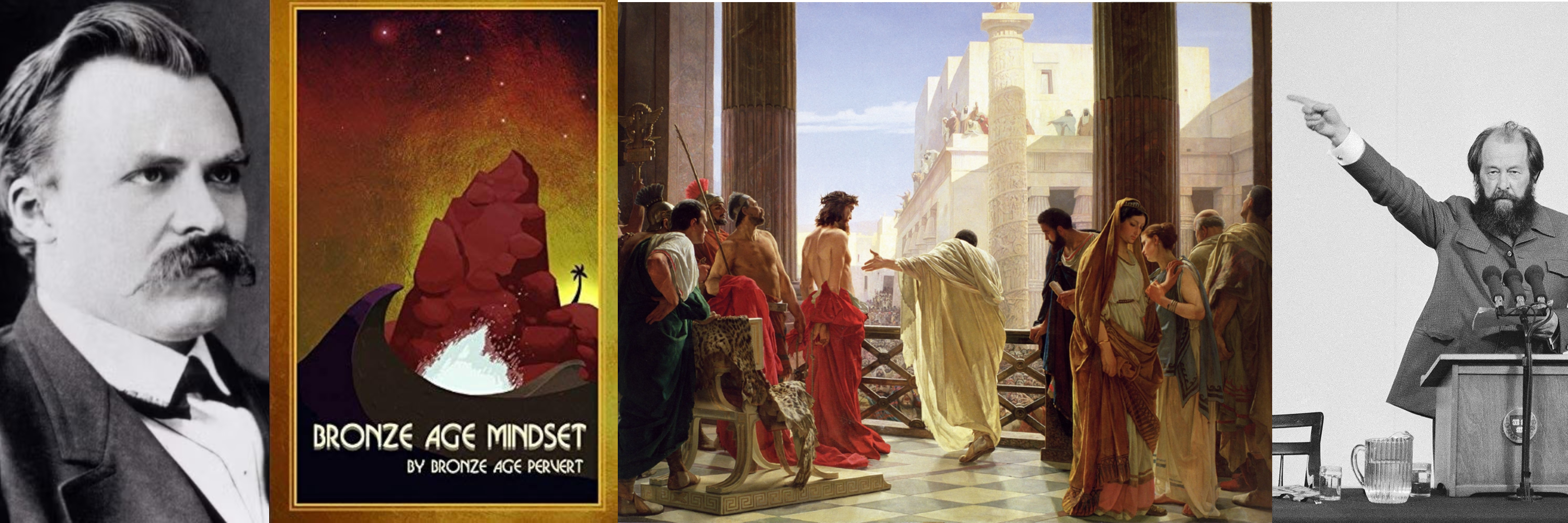
Count up all the Christian and conservative essay-denunciations of Bronze Age Pervert and his book Bronze Age Mindset. By the end, you will conclude that BAP and his book must be the chief culprits for the social ills that most vex these social conservatives: the disintegration of the family, the decline of the church, and the dysfunction of the American republic. Why else would every corner of the “traditional” right raise their voices in unison to attack him? (We won’t even get into the denunciations from the Left.)
But unless BAP has used Game on your wife and stolen her from you, he bears zero responsibility for the collapse of families and degradation of polities. Due to some evangelical Christian leaders’ taste for cuckoldry, however, this is a real possibility. But it has never been proven that BAP was involved! So why all the denunciations?
I will not attempt an explanation - though I have my theories. Nor will I attempt to vindicate him or his book against his accusers; I think it is simply obvious that BAP is not responsible for abortion, gay marriage, transsexualism, or whatever other diseases have infected and brought down the formerly Christian body politic. Instead, I would like to do something even more scandalous: demonstrate the kinship between Christianity and BAP’s philosophy, and argue that they are allies not just for tactical or political reasons, but for spiritual ones.
Two Exhortations
Just as the kindred relation of two brothers is most clearly made manifest by placing them next to each other, so juxtaposing BAM with a similar Christian work should suggest the deeper relation between BAP’s vitalism and Christianity. But it will not do to compare BAM to the Bible, or to Christian theology like Thomas Aquinas, or to apologetics like C.S. Lewis. Like must be compared to like. Instead, I want to look at a Christian exhortation. An “exhortation,” after all, is BAP’s own description of his book, both in the subtitle (found on the title page) and in the Prologue.
This complementary Christian exhortation bears more than one similarity to BAM. It is also the product of an eastern European mind that landed in America, and as such, demonstrates an awareness of both liberal Western life as well as life under communism. It was also, like BAM, on the receiving end of a blast of denunciations from both left and right. Finally, it is a comparison invited, in a way, by BAP himself, who in an essay in The American Mind, compares his book to the samizdat of Soviet bloc dissidents.
This Christian exhortation is Aleksandr Solzhenitsyn’s “A World Split Apart,” the commencement speech he delivered (in Russian) to Harvard University’s graduating class of 1978. While Solzhenitsyn does not call the speech “an exhortation” it can accurately be described as such. As in BAM, so in Solzhenitsyn’s speech: before the exhortation to something better can begin, the problem must be named. Here is how Solzhenitsyn’s speech begins:
Harvard’s motto is ‘Veritas.’ Many of you have already found out and others will find out in the course of their lives that truth eludes us as soon as our concentration begins to flag, all the while leaving the illusion that we are continuing to pursue it. This is the source of much discord. Also, truth seldom is sweet; it is almost invariably bitter.
Solzhenitsyn then proposes to offer some “bitter truth” to his audience. What is the nature of this bitter truth? His American audience may have expected the world “split apart” to refer on the one hand to the liberal West which had welcomed him, and on the other to the communist East which had expelled him. If Solzhenitsyn’s American hosts had been expecting commendation from the Russian dissident, they were disappointed, even devastated, by the speech itself.
He attacked the western media:
Hastiness and superficiality - these are the psychic diseases of the twentieth century and more than anywhere else this is manifested in the press. In-depth analysis of a problem is anathema to the press; it is contrary to its nature. The press merely picks out sensational formulas.
He attacked western academia:
Your scholars are free in the legal sense, but they are hemmed in by the idols of the prevailing fad. There is no open violence, as in the East; however, a selection dictated by fashion and the need to accommodate mass standards frequently prevents the most independent-minded persons from contributing to public life and gives rise to dangerous herd instincts that block successful development.
And he accused the American antiwar movement of being “accomplices in the betrayal of Far Eastern nations, in the genocide and the suffering today imposed on thirty million people,” because of their role in breaking the will of the American people in the Vietnam War.
“Do these convinced pacifists now hear the moans coming from there?” he asked.
But perhaps most shocking of all is the true meaning of the title: the split between the liberal West and communist East is only a superficial division compared to the world’s universal ailment, shared by East and West alike:
We have lost the concept of a Supreme Complete Entity which used to restrain our passions and our irresponsibility. We have placed too much hope in politics and social reforms, only to find out that we were being deprived of our most precious possession: our spiritual life. It is trampled by the party mob in the East, by the commercial one in the West. This is the essence of the crisis: the split in the world is less terrifying than the similarity of the disease afflicting its main sections.
Solzhenitsyn was Russian Orthodox; the term “Supreme Complete Entity” is a rhetorical peace flag to his Harvard audience. Already, though, we find what seems a fundamental antagonism between Solzhenitsyn’s and BAP’s exhortations.
Solzhenitsyn, for his part, mourns the restraint that in yesteryear accompanied belief in a Supreme Complete Entity. BAP by contrast confesses:
I don’t talk about if God exists, I don’t know this. I’ve never had any feelings for this one way or another. I’ve sat in houses of religions, but I always felt nothing, it put me to sleep. Even the novelty of a Buddhist or Hindu temple wore off very fast: I enjoyed the spectacle but could tell…these priests are just more piledrivers. I was always so bored.
And you couldn’t possibly say that BAP counsels Solzhenitsyn-style “restraint.” It would be more accurate to characterize his counsel, drawn from the example of the Greeks, as hubristic self-assertion: “The secret desire of every Greek…the Bronze Age mindset…was to be worshiped as a god!”
I think that most Christians and conservatives would be satisfied with this outline of the antagonism between vitalism and the broad Christian tradition, and would thus reject BAP and his book. Many vitalists too, I believe, would see their difference with Christians along these lines (among others). BAP himself, however, is cleverer than most of his critics (as well as most vitalists), and sees Christians as allies, something Christians seem not to have picked up on.
BAP’s Hand of Friendship to Christians
Toward the end of BAM, giving practical advice for organizing to his readers (alternately “frogs,” “nationalists,” or “the right”), he tries to dissuade them from subverting Christianity and reintroducing paganism:
No independent pagan tradition exists in the western world, and playacting in that way is going to fail. Offending Christians in political movements is stupid, when they’re one of the last bastions against a common enemy.
Why have none of BAP’s denouncers mentioned this? BAP does not hesitate to advise his readers to consider entering into important institutions like parasites, hiding their beliefs, and finding ways to use the host institution for nationalist ends. He does not encourage his readers to do this in churches. Why? Not because Christianity is inconsequential. He says it is “one of the last bastions” that also opposes what frogs oppose.
The best explanation is that BAP respects Christianity - and you don’t subvert what you respect. There is another telling passage of BAM that its denouncers never mention. In “Part 3: Men of Power, and the Ascent of Youth,” he uses a seven-page mega-aphorism to praise the Christian navigators and conquistadors of the Age of Exploration in more effusive terms than I have ever seen them praised anywhere, by anyone. Here’s a sample:
Perched on the beaches of the great Eurasian mass, these men went, in just a hundred years, from sailing a few almost-rafts that they barely knew how to navigate, to explorers of new worlds and founders of global empires that lasted for centuries. You must understand how amazing this feat was: there was no tradition of seamanship in Portugal or Spain, let alone France or England…it all had to be done from scratch. Do you know at all to respect the sea? If you’ve ever traveled a ferry on even a relatively calm sea like the Adriatic, on a windy day a large modern ferry, as big as a city block…it will swing right and left. You won’t be used to it. The Atlantic has waves ten feet or more as a matter of course and these men were traveling on wooden ships with 15th Century tech; you must be crazy to have no awe of this.
While his praise is unambiguous, couldn’t it be argued that Christianity is more an accident of these explorers’ lives? Or is his praise for them a sign of respect for the Faith on BAP’s part?
The evidence points to the latter. BAP is awestruck by the achievements of these men, and not only does he marvel that the modern Church does not celebrate them, but he encourages his readers to view the explorers and conquistadors through the eyes of Providence:
They’re [the explorers] the direct descendants of the crusaders who liberated Spain and other parts of Europe. The Church doesn’t want to admit that once Ferdinand and Isabella cleared Spain of the enemies of Christ God blessed that nation with a century of prosperity and pre-eminence, and gave it the foundation of world-empire.
BAP views the Spanish discovery and conquest of the New World as an act of God, meritorious recompense for the expulsion of Muslims from western Europe in the Reconquista. If you’re a Christian, you don’t have to accept his analysis of Providence - but has anyone within your church ever encouraged you to think this way? Even if you don’t believe it is correct, it can hardly be called anti-Christian.
Even more astounding, though not as immediately remarkable, is a single sentence from the same passage, about Nietzsche. References to Nietzsche abound in BAM, so the German’s presence here is not itself telling. Elsewhere, BAP has said that BAM simply represents his attempt at a faithful interpretation and popularization of Nietzsche. What is so surprising, though, in this particular reference to the philosopher in connection with the Providence-guided explorers, is that we find the only criticism of Nietzsche (by my count) in the entire book. Here is the line: “Even Nietzsche stays away from them [the conquistadors] and, in a moment of weakness, speaks nonsense about the ‘superiority’ of the Aztecs.”
BAP’s respect for the Christians who discovered the New World, settled and colonized it, and carried Christianity to it, is immense enough for him to indict his own teacher’s error - this one time. It is the only time he does so in the whole of his book.
When comparing BAM to the exhortation “A World Split Apart”, we can see evidence for maintaining the conventional opposition between Christianity and vitalism. And yet after the Greeks, no one rates as highly for BAP as the Christians of the Age of Exploration. And he sees the church in the West as one of the few institutions where allies might be found; despite all this, Christians and other conservatives have repeatedly denounced BAP, denounced Nietzsche, and denounced the vitalist right. It does not have to be this way.
The Conspiracy Against Greatness
I said earlier that these exhortations begin with a statement of the problem before the positive, or the productive, aspect of the exhortation occurs. A simplistic, surface-level understanding of Solzhenitsyn’s speech would, as discussed, come into direct and immediate conflict with BAM. He seems to say that everyone just needs to believe in God again, and then we’ll all be more virtuous, and our problems will be solved. This is no doubt what Christian conservatives want to hear, and insofar as Solzhenitsyn says that, they laud him, and insofar that BAP does not, they criticize him.
But let us try to penetrate to the real critique, the “bitter truth” that Solzhenitsyn speaks to his American hosts - the same one motivating BAP’s own exhortation. It is this: The modern world is a conspiracy to strangle human greatness.
If you want a picture of the present, imagine kudzu rolling across a forest like a deciduous tsunami, inundating all life. It covers the ground like carpet, then keeps going, snaking up trees, coating and strangling them. What was a forest is now a forest-shaped kudzu biome. A thin, creeping vine - a form of life - poisons life. Where kudzu rules majestic old growth trees fall to the floor as dead wood. This is life in the modern world.
The freedom we enjoy is freedom to spread horizontally and never upwards.
What hardy seedlings of pine or beech or maple might sneak through the undergrowth are wrapped and choked by thin vines ever watchful for disturbance, ensuring no pillars ever rise up and tower above.
Solzhenitsyn calls this “humanism.” In the West, he says, humanism took the whip hand in the Renaissance and has remained the master ever since. In rejecting “the spirit” and embracing “the material” humanism eroded the Christian foundation stones of the West, until the early modern Christianized humanism totally collapsed, leaving something much more crass. The virtue of, for example, the early American republic, gave way to humanistic materialism in a “purer,” and for that reason more dangerous, form:
Everything beyond physical well-being and the accumulation of material goods, all other human requirements and characteristics of a subtler and higher nature, were left outside the area of attention of state and social systems, as if human life did not have any high meaning.
Continual horizontal spread, the accumulation of ever more resources for life with no concern for or even awareness of what might rise above knee-height: This is a world engulfed in kudzu. Solzhenitsyn summarizes it well: “The search for the best ways to obtain material goods and then their carefree consumption.”
For his part, BAP refers to this phenomenon of a lower life hostile to higher life as “yeast”:
There are two kinds of life, and yeast is different from higher life. Higher life… at its most basic has to do with differentiation and structure. Yeast is an “amorphous blob” that expands, whereas a higher organism has different parts with different functions, different organs, different systems within itself.
Compared to a simple fungus like yeast, the human organism occupies the opposite pole of complexity. But will a man choose to live accordingly? Do men act according to their natures? Some do not - indeed, BAP cites Heraclitus to this effect. In fact, most fail the test: “[Heraclitus] is very right when he says, ‘The best desire one thing above all, ever-flowing eternal fame among mortals; but the many glut themselves like cattle.’ This is what I believe in!”
If it is a stretch, then, to compare a man to yeast, then we can at least follow Heraclitus in saying most men betray their nature and resemble cows. BAP has numerous terms for this state of life - it is one of his central concerns in the book. One such is “bugman.” It is a perennial type, he says, both ancient and modern:
The peasant and the serf, the default state of mankind, has, like animal, his nose directed toward the earth and the ground, because it is there that the objects of interest are found, the needs of bare life… The dwellers of the valleys and the tillers of the soil are the prototype for all the modern “bugmen,” don’t be fooled otherwise. This is the ‘frame’ or worldview that turns all matter and all things into mere utilities.
Solzhenitsyn and BAP might differ on the question of how and why the Bugman arose. Solzhenitsyn argues that the bugman is a development of the liberalism born from the womb of the Renaissance, BAP that he is a recrudescence of ancient peasant life held at bay in the West till now. But the intellectual genealogy is not the central concern. Both agree: yeast-life, bugmen, carefree consumption of material goods, this is the regime of the present. As BAP memorably says: “their true ruler is the god of gravity.”
Kudzu Tyranny
For its low foundations, are not these limited aspirations a good thing? By keeping our gaze lower down, we can avoid a repeat of such catastrophes as the Wars of Religion and nationalistic world wars, right? Aren’t private vices public benefits? Solzhenitsyn and BAP agree, it turns out, on a further point: the regime of kudzu necessarily entails a suffocating tyranny all its own. The modern problem lies not merely in men’s distasteful preference for kudzu, but in the aggression that necessarily goes along with it. Kudzu strangles. It is actively hostile - not merely agnostic - to greatness. And why not? He who would grow a pine must rip out the kudzu first.
Solzhenitsyn and BAP alike are wise enough to distinguish between the tyranny of a communist regime and that which is found in the liberal west. America is not “literally the Soviet Union.” That does not mean, however, that tyranny is unknown in the West. America, for example, boasts of the freedom of the press. But the media, Solzhenitsyn says, is both a sign of the engulfing yeast-life, and one of its causes:
The press has become the greatest power within the Western countries, exceeding that of the legislature, the executive, and the judiciary. Yet one would like to ask: According to what law has it been elected and to whom is it responsible?
Somehow, even without being appointed directly by government officials (as in the Soviet Union), Western journalists exhibit the same rigorous adherence to a party line. The freedom of the press, therefore, goes only one way: “Unrestrained freedom exists for the press, but not for the readership, because newspapers mostly transmit in a forceful and emphatic way those opinions which do not too openly contradict their own and that general trend.”
The rise of digital media has begun to fracture this power - first of all, by demonstrating how correct Solzhenitsyn was. The persuasive power of the supposedly free press’s consensus was at its height when no one realized the consensus existed. When journalistic agreement appears to the reader or viewer as uncontested reality, no one wonders whether we have an American Pravda. But the arrival via digital media of ideas totally opposed to mainstream talking points was like color suddenly appearing on the television sets of our parents.
Is it any surprise that the mainstream media has gone to war with Elon Musk since he bought Twitter? Like Solzhenitsyn, Musk recognized that true freedom of speech was threatened in the West by the “freedom” of the press. By allowing people to publicly disagree with journalists, he is breaking their power. His X (if it could be liberated from the perverse incentives for paid posting which he foolishly introduced), could be a digital antifungal for clearing out yeastlife, a decentralized muckraking operation for the 21st century. How different is this from what mainstream media has become! As X breaks their power, in impotent rage they turn their enormous institutions towards attempting to doxx the anons of the Right. The asymmetry in power and prestige between legacy media and anon posters is staggering to behold. Is this the “speaking truth to power” that the media is always going on about? Solzhenitsyn asked by “what law has it been elected” and “to whom is it responsible”? To whom indeed?
You should be able to see now what is the effect of having a guild of Pravda journalists in the liberal West: choking out higher life. If the modern world is a conspiracy to strangle human greatness, and the press the greatest power in it, then you know that we are looking at the enemy who has been sneaking into the fields at night to plant the kudzu. In Solzhenitsyn’s day, the press’ role in manufacturing America’s defeat in Vietnam and ousting Richard Nixon from the presidency was obvious to anyone–though there were precious few at the time–who had refused to believe the media’s auto-hagiography concerning the Pentagon Papers, Deep Throat, and Woodward & Bernstein. As Solzhenitsyn says:
The press can act the role of public opinion or miseducate it. Thus we may see terrorists heroized, or secret matters pertaining to the nation’s defense publicly revealed, or we may witness shameless intrusion into the privacy of well-known people according to the slogan ‘Everyone is entitled to know everything.’ But this is a false slogan of a false era; far greater in value is the forfeited right of people not to know, not to have their divine souls stuffed with gossip, nonsense, vain talk.
Without formal censorship, the liberal West has nevertheless dramatically narrowed the scope of public discourse and ensured that public priorities revolve around “the achievement of happiness, in the debased sense of the word.” It follows, then, that great men should be absent. Surveying the United States of 1978, Solzhenitsyn affirms it:
A great statesman who wants to achieve something important and highly constructive for his country has to move cautiously and even timidly; thousands of hasty (and irresponsible) critics cling to him at all times.
Where have all the great men gone? The way of Richard Nixon, who represented a cataclysmic rejection of the social revolution of the ‘60s: a single tree strangled and felled by a thousand invasive vines. Having given themselves over to the concerns of cattle, people have, cancer-like, grown a “petrified armor around [their] minds.” What could possibly pry open this petrified armor? Can anything kill off the mental kudzu tangling up the souls of the young men who in better times would have been hacking away at it the moment it appeared? The benign herbicide seems to be a profane and ungrammatical exhortation self-published on Amazon which weaves back and forth between Nietzsche, the Greeks, early modern Europe, evolutionary science, and current events.
In fact, BAM contains its own image that conveys a similar sense of rigidity and captivity as Solzhenitsyn’s “petrified armor”: the Iron Prison. BAP’s anthropological origin account of the Iron Prison is distinct from Solzhenitsyn’s, but so many of the particulars of the diagnosis are similar that it is worth quoting BAM at length:
Everything you hate about modern life and that makes it into an Iron Prison - and I agree it is a prison - represents a return of the endless sallow night of matriarchy. It is a return in every way, you must understand this literally! Nietzsche says that in the modern Europe you see the reassertion of pre-Aryan modes of life, the return of socialism, of the longhouse, of feminism, and that this is happening also to us internally, where the higher instincts of the spirit are being overtaken physiologically by the retrograde and prehistoric. The life of the village and of the primitive is one of utter subjection, total domestication and total brokenness.
BAP’s point here is best understood in the context of Nietzsche’s theory of Indo-European origins and these pastoralists’ conquest of neolithic European farmers (which has in many ways been vindicated by multiple fields of scholarship, including paleogenomics, despite the best efforts of the debunkers). Nevertheless, even without going into all that, the main point is this: the supposed “philosophies” and “ideologies” of egalitarianism, far from being novel, are atavisms, revivals of the agricultural communalism that was swept away in the Indo-European conquest.
While Solzhenitsyn does consider materialism and egalitarianism to be novel developments of humanistic philosophy, the important point on which they agree is that this panoply of leveling ideas is in essence one unified conspiracy to break young men and prevent them from grasping greatness. Solzhenitsyn’s “great statesmen” chained up by a thousand hasty critics is the young man, castrated by the longhouse council. That statesman and that young man alike, because of their propensity for energetic conflict and their desire for personal distinction, threaten the feeding trough that feminism, socialism, Human Resources departments, DEI, and all the rest worship.
Is it any wonder that, from a historical point of view, one of the most striking and unique social achievements of the modern world is never-before-seen levels of obesity?
For now, our Western liberal democracies look different from the totalitarian states of the East, even though the bovine animating principle is shared in common. The velvet fist approach in the West is made possible by the same consensus cabal which Solzhenitsyn identifies: the press and the universities. I cannot fail to quote probably the most hilarious passage in all of BAM since it is relevant to this point. Do not be misled, BAP warns, by the rich gilt brocade around the wrist of the velvet glove worn by the wardens of the Western and “liberal” Iron Prison:
Should the tyranny that has descended on our age ever gain the power it seeks and then be challenged enough to feel itself in danger, the mass annihilations that will be carried out by homosexual, transsexual, and especially lesbian commissars will exceed in scale and cruelty anything that has yet happened in known history. Imagine lesbian mulatta commissars with young Martin Sheen face and haircut manning the future Bergen-Belsens, installations that will span tens of miles.
What Is Restraint?
Even though both BAP and Solzhenitsyn detest the soft egalitarian tyranny of the West, is a further understanding between them possible? Christians counsel restraint; vitalists, hubris and self-assertion. As we have seen, in his speech Solzhenitsyn says, “We have lost the concept of a Supreme Complete Entity, which used to restrain our passions and our irresponsibility.” BAP’s social conservative denouncers would enjoy this line, I imagine.
But how does this Conservative Inc.-approved point square with Solzhenitsyn also bemoaning the caution that great men are shackled due to their unworthy critics? How can Solzhenitsyn call for renewed restraint while also calling for an end to the stultifying proceduralism and legalism of the West? Hoping for a great man who will overthrow the mediocre legal regime of the Western world does not sound like Burkean prudence. If indeed Solzhenitsyn is recommending Burkean prudence…
In fact, Solzhenitsyn and BAP are playing the same tune, one in a minor and the other in a major key. When Solzhenitsyn calls for “restraint,” that should not be read as conservatism or gradualism. Solzhenitsyn is calling for restraining the cattle-like appetite made manifest in the morbidly obese who grow more ravenous the more they feed until all they can think of is how to consume more food. Restraining the impulse to the feed trough is a necessary precondition for a great man to finally arise - and succeed.
What recompense can a truly great man enjoy? If he has restrained his bovine desire for a hungry belly, there is no material reward that could appeal to him. Heraclitus calls this reward for a great man “glory.” Perhaps the eponymous “mindset” which BAP lauds is not so far from Christianity.
While it might seem distasteful to Christians to admit that BAP is their friend (even though he has already come more than halfway to you), the reading I’ve proposed above calls for a hand of Christian friendship. And this reading is further justified because it helps explain other aspects of BAP’s book. If he, as I have argued, is united with Christians in a quest for something higher than bestial comforts, we should find in him a comrade in arms against the old enemies of Christianity who view man as just some other mammal that passes on its genes through sexual reproduction before dying. Christians spent the ‘90s and 2000s debating just such a group of people - the “New Atheists.”
Beyond the Brazen Dome
The Bible studies, apologetics courses, and video series meant to equip Christians for combat against these excitable Darwinian atheists might seem like ancient history. But many of them have appeared again in the news, as refugees from the strangling kudzu they once cultivated. The liberal political concerns of these materialists revolved around ensuring a maximally peaceful and comfortable life for the largest herd of human cattle as possible. That is why “religious extremism” was one of their primary targets. Any creed or philosophy that concerns itself with something other than the feed trough is inherently in a state of war - even if it is cold and undeclared - with materialist yeast-life. So the New Atheists sought to seal off the heavens with a brazen dome. That way no human cattle would threaten the herd by forsaking his stomach by looking up for something higher.
Selective breeding may turn out to be better than what is now more and more common: the life of a human-chimp jerking off in captivity which results in no breeding at all.
The more that the men of the West were hustled into the longhouse at the behest of liberals (including the New Atheists), the poorer that the peace- and comfort-making tools of the West, which those New Atheists so loved, worked. Technological innovation, scientific inquiry, deliberative democracy, free markets, and magnanimous public-spiritedness: these, among other things, produced the world of prosperity and peace that the New Atheists cherished. Much to their chagrin, however, a narrow focus on the fruits of these virtues could not maintain their efficient functioning. Paradoxically, it is only men who lust after the heavens beyond the brazen dome who can maintain and improve the earth-bound machines which create comfort down here.
Happily, it seems, the sight of that brassy ceiling may yet remind some of an older age of bronze. The castle of civilizational excellence has never and never will be built upon the low foundation of the longhouse. It is not for nothing that great American men, from Adams to Lincoln to Reagan, were interested in spiritual powers often in unorthodox ways. Yet we, as Christians, have made our peace with these men. Why not BAP? Aim for the heavens and get the world thrown in as well; aim only for the world and you will forfeit both. Or, as one Man put it, “seek first the kingdom of God and His justice, and all these things will be added to you.”
If the remaining New Atheists are not all fully penitent, they are at least chastened. Richard Dawkins now calls himself a “cultural Christian.” But why worry about the New Atheists? To gloat? No, but because it is with them that BAM begins. Here too Christians can find another point of spiritual contact with BAP.
It is strange, perhaps, to find at the beginning of a philosophic exhortation an argument that the central doctrine of evolutionary biology is false. Modern theorizing about life begins with the axiom that organisms seek to survive long enough to reproduce and pass along their genes. BAP denies this, or at least strongly qualifies it. His whole argument is not relevant to the point I am making here, which is simply to point out this essential agreement between vitalists and Christians: materialistic explanations do not suffice to explain life. Life seeks something higher - man most of all. Or as BAP puts it:
Life has a thing inside it that reaches beyond itself. This is intergalactic worm, I can’t say here, you must wait. But if you don’t reach beyond yourself you are dead! Most of mankind is the walking dead.
Since in his view “happiness” in its degraded form - bovine life - has become the overriding concern of the modern world, would Solzhenitsyn disagree with such a claim? Here is the “bitter truth” he presented the Harvard crowd with back in 1978. Smart, successful, promising, rich - and dead. Solzhenitsyn was speaking to the best and brightest zombies of a zombie-nation there in Harvard Yard.
Yet neither BAP nor Solzhenitsyn despaired of their walking dead audience - that is why they wrote. It is why I write! You are jerking off, as BAP says, because you are in captivity. Get out! There is a thief who put you inside the enclosure. Jesus announced himself to be the enemy of the thief: “The thief cometh not, but for to steal, and to kill, and to destroy: I am come that they might have life, and that they might have it more abundantly.”
Life more abundantly. An intergalactic worm. This is not the life of the belly! It is something great, something beyond your chimp imagining! You see it only darkly... Who will shatter the bars of the iron prison, fracture the petrified armor around the mind, pierce the brazen dome, burn down the festering longhouse, ignite the kudzu of modern life and incinerate it forever? What would such a thing look like? It will be new, so until it arrives you cannot know it. But whatever it is, Solzhenitsyn says:
It will demand from us a spiritual blaze; we shall have to rise to a new height of vision, to a new level of life, where our physical nature will not be cursed, as in the Middle Ages, but even more importantly, our spiritual being will not be trampled upon, as in the Modern Era. This ascension is similar to climbing onto the next anthropological stage. No one on earth has any other way left but - upward.
The possibility and desirability of this “upward” is what unites Christians and vitalists, as well as the further conclusion that some will approach or attain it, and others will not. In one word: distinction. The love of what is true and hatred for what is false. The love of what is beautiful and hatred for what is ugly. The love of what is good and hatred for what is bad. The pretension of the compassionate modern man must be burnt away. What better image of a modern pharisee can we find than the “man of compassion”? These are the hypocrites and play-actors who infest every age. Jesus met them. So have we.
“The bugman pretends to be motivated by compassion,” BAP writes, “but is instead motivated by a titanic hatred of the well-turned-out and beautiful.” The modern world belongs to the bugman: it is a conspiracy to strangle human greatness, to turn us towards our belly. Seen this way, the modern world is simply the world that belongs to the Left.
Left Versus Right
It is more than a political party or orientation; the Left is a metaphysical reality. While we (providentially) associate the politics of égalité with the left-hand side because of the seating arrangement of the French National Assembly, the continuous existence of this bloc of bugmen is not a contingent accident of Western history, but an assured feature of life; it is the party of hatred, of resentment, of egalitarianism. And it is opportunistic. The Left emerged as a powerful and attractive force in Europe because of the self-satisfied complacency of the reigning party of distinction, that is, the Right. Sensing an opening, it invaded. It won, and made many of the worst excesses of the modern world.
While England and America seemed at first to show a way forward for the party of distinction to come to terms with an industrialized world, on the Continent the party of égalité tore down both throne and altar, and the rest of the West followed, each nation in their own way.
Since then, the parties of the Right have - with few exceptions - represented either one of two things: either a reaction against the Left and the hope for a restoration that with every passing year grew ever more hilariously impossible, or alternatively a moderating “conservative” Left, a “respectable” bugman party that seeks only to slow down the spread of the yeast, and accommodate more of it with every generation.
BAP is not a conservative; but neither is Solzhenitsyn. Christians and vitalists must wrestle each other upward to a new synthesis, seeking a third thing - neither restoration of throne and altar (or some early republican American equivalent) nor a loser’s accommodation to a defeat that grows more thorough with the passage of time. This is the “ascension” to the “next anthropological stage” which Solzhenitsyn points his listeners to. A truly new Right that can bury the Left will not be reactionary; nor will it be conservative.
“Conservatism” perhaps fit the party of distinction when monarchy, aristocracy, and established church held real power and contributed to the energy and prestige of the British Empire. “Reaction” perhaps fit when crowns had been cashiered but the rise of socialism on the Continent gave their gold a new gleam. But all that is gone, and the usefulness of both conservatism and reaction is as well. The Right, the party of distinction, surveys now the smoking plain. What had been glorious mountain is now dirt, leveled by the infernal machines of the Left.
The Right must build something new. Its first responsibility? To prepare itself for divinity:
If a god showed himself today to you, in a dream, would you have the inner energy and power to honor him and do his bidding in the world? Or would you, neutered by the modern pervasive hivemind of the slave, dismiss it, and yourself as unreal or unworthy, when it is the modern bugman and his blabbering that lacks reality.
The spiritual task lying before us is at once self-evident and ineffable. When that work is accomplished, when the task is done, it will seem to us to have been as inevitable as when, at the end of a long moonless night, the sun begins to rise.
Hear hear☦️
Fantastic article!
Interesting article.